
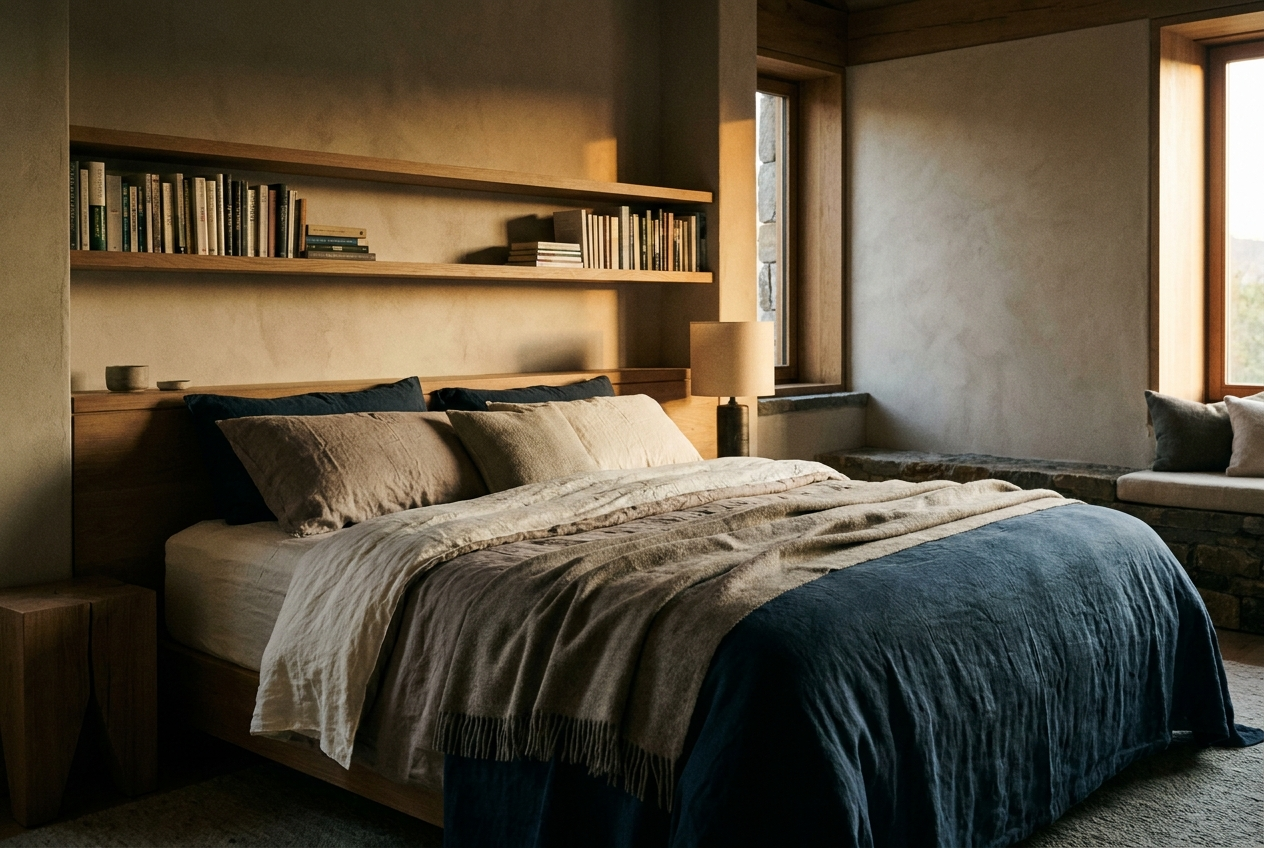
Most of us treat our bedrooms like a secondary office. We bring the blue light, the urgent pings, and the heavy weight of the workday right into the one place where we’re supposed to actually let go.
I’ve realized that if you want to reclaim that hour before sleep, you need more than a “night mode” setting on your phone. You need a physical barrier between you and the digital world. The best shield I’ve found is a simple stack of books.
The tangible landscape of print
It sounds a bit idealistic, but the physical presence of books changes the energy of a room. Maryanne Wolf, a psychologist who wrote Reader, Come Home, talks about how our brains need a stable and tangible landscape to truly focus. Digital text is slippery because it is meant to be scrolled past. A physical book has weight and texture. It stays where you put it. It acts as an anchor for your attention that doesn’t demand you click or swipe anything.
The 6-minute nervous system hack
There is actually a lot of science behind the “book nerd” feeling of calm. A study at the University of Sussex found that it only takes six minutes of silent reading to drop your stress levels by 68 percent.
What is interesting is that reading actually worked better than most other things we do to unwind. It beat out listening to music, drinking a hot cup of tea, or even going for a walk. It is like a manual override that tells your nervous system to stop looking for problems and start preparing for rest.
Stop blasting your retinas
We don’t notice it, but our eyes are in vigilance mode all day. We blink 50 percent less when we are staring at pixels. Reading a real page gives those tiny ciliary muscles in your eyes a chance to finally let go. Instead of light being fired at you, the paper just reflects the warm light from your lamp. It is a huge physiological relief that signals to your brain that the visual demands of the day are done.
The melatonin trap
Harvard researchers did a famous study on this. They found that people reading on screens before bed actually delayed their circadian rhythms by over an hour and lost a huge chunk of their REM sleep. Because blue light suppresses melatonin, the screen readers woke up feeling like they had been hit by a truck. The print readers had no disruptions at all.
How to start
You don’t need a massive, floor-to-ceiling library. Just clear the junk off your nightstand and pick three or four books that are low on adrenaline. I like poetry or slow essays, the kind of writing that doesn’t make me want to stay up until 2:00 AM to find out who the killer was.
Turn off the big overhead light, switch on a warm amber lamp, and let the weight of the paper do its work. The day is officially over.
Editorial Sources & Citations
- Design & Spatial Psychology: The New York Times, “How Home Libraries Became the Ultimate Status Symbol” (December 2024). https://www.nytimes.com/2024/12/03/realestate/home-library-design.html
- Cognitive Science of Reading: Reader, Come Home: The Reading Brain in a Digital World by Maryanne Wolf (HarperCollins, 2018). https://www.harpercollins.com/products/reader-come-home-maryanne-wolf
- The Stress Reduction Study: Dr. David Lewis, Galaxy Stress Research (2009), Mindlab International at the University of Sussex.
- Digital Eye Strain Metrics: American Optometric Association, “Computer Vision Syndrome” (AOA Clinical Guidelines). https://www.aoa.org/healthy-eyes/eye-and-vision-conditions/computer-vision-syndrome
- The Melatonin & Sleep Study: Chang, A. M., et al. (2015). “Evening use of light-emitting eReaders negatively affects sleep, melatonin, and next-morning alertness.” Proceedings of the National Academy of Sciences. https://www.pnas.org/doi/10.1073/pnas.1418490112